
Security and responsible disclosure.
Vraelis is building the trust layer for AI in the physical world: defense, critical infrastructure and autonomous systems. This page sets out where development stands, what to share with us, and how to report a security issue.
The public site provides information, a way to contact us, and the Vraelis Prompto downloads. Report a vulnerability in Vraelis Prompto as its repository's SECURITY.md describes. Vraelis Contour and its evidence app are in private development.
Development is not an operational deployment.
Earlier browser-checking features and implementation references do not establish a deployed AI-security service. There is no publicly available enforcement gateway or certified physical-system protection.
- Product
Controls are being developed privately
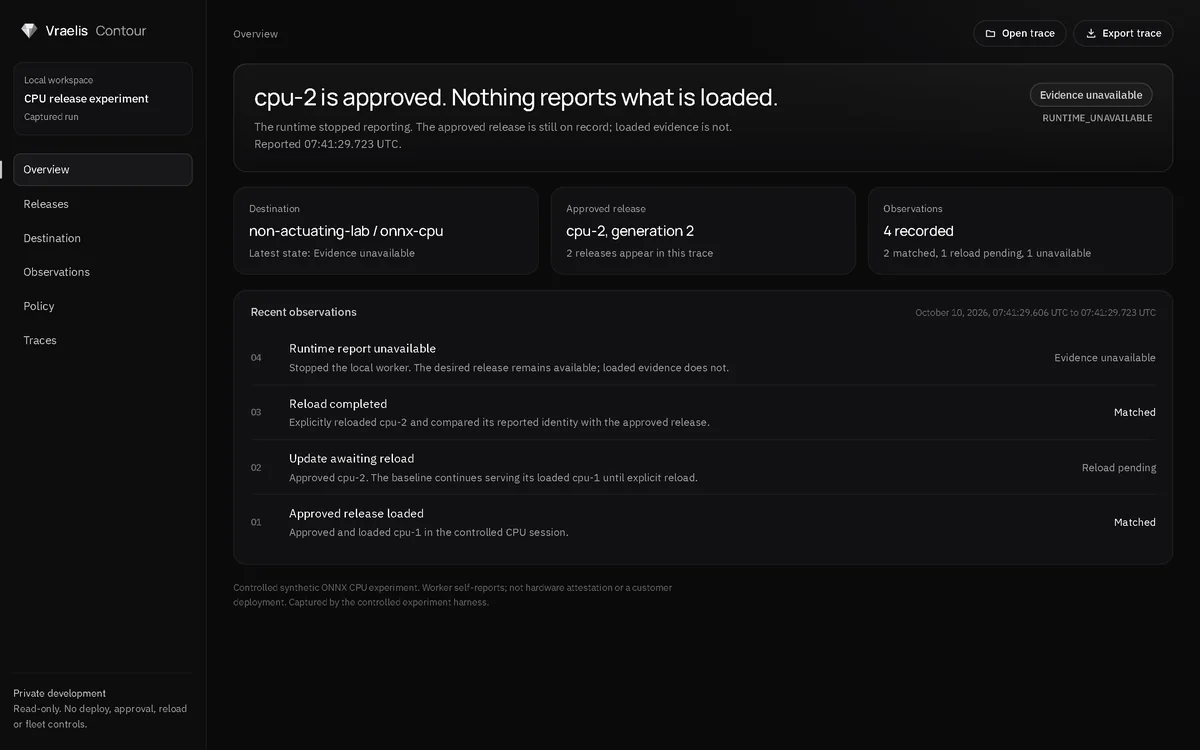
The published Vraelis Contour reference is a controlled synthetic ONNX CPU experiment with signed release and approval bindings, runtime policy enforcement and recorded observations, plus a read-only evidence app. Runtime reports are trusted worker self-reports. It does not establish a customer deployment, live Kubernetes integration or hardware attestation.
- Assurance
Evaluate the system and its limits
Research topics, design intentions and local tests are not certifications. Any future deployment must be evaluated against its actual interfaces, threat model and operating environment.
- Access
Public account access is closed
The site does not offer a self-service product account, production API or operational deployment. A contact submission does not grant access.
The experiment records comparisons between approved releases and trusted worker reports. Its evidence app checks imported records for internal consistency, not authenticity. Earlier browser-testing documentation describes a retired product and does not establish current Contour capabilities.
Share only what belongs in an inquiry.
Please keep credentials, classified material, restricted technical data and sensitive operational information out of public contact forms.
- Inquiries
Start with a description
Describe the system and security problem at a level you are authorized to share. Do not attach a live secret or operational dataset to explain the issue.
- Privacy
Use the privacy channel
Privacy and data-rights requests have a separate contact path. They do not require organization details or a commercial acknowledgement.
Tell us, and a person reads it
Email [email protected] with Security report in the subject. Say what you found, the address where it happens, and how to reproduce it.
- Test only systems you own or are authorized to test, and stop as soon as you can show the problem.
- Do not open, change or keep anyone else's data. If you reach some by accident, tell us and delete it.
- Give us a reasonable chance to fix it before you publish anything.
security.txtRFC 9116
- Contact
- [email protected]
- Preferred-Languages
- en
- Expires