Autonomous systems
AI security for autonomous systems.
Robots and vehicles get model updates in the field, often from a supplier.
Why it matters
Models ship to machines in the field.
Updates land in someone else's fleet
In a facility or fleet the supplier does not operate.
The wrong release is a security event
A different release, or the wrong machine, changes what it does.
The first question is which model
When a machine surprises you, the answer should come from a record.
HypothesisRobotics is one segment we study. Release and platform engineers at robotics suppliers and integrators meet this problem early.
How Vraelis Contour would apply
How Vraelis Contour worksFive steps, release to record.
Identify the release
Bind approval to the release and destination
Destination-bound approval: one machine's approval does not cover another.
Integrate with a supported runtime
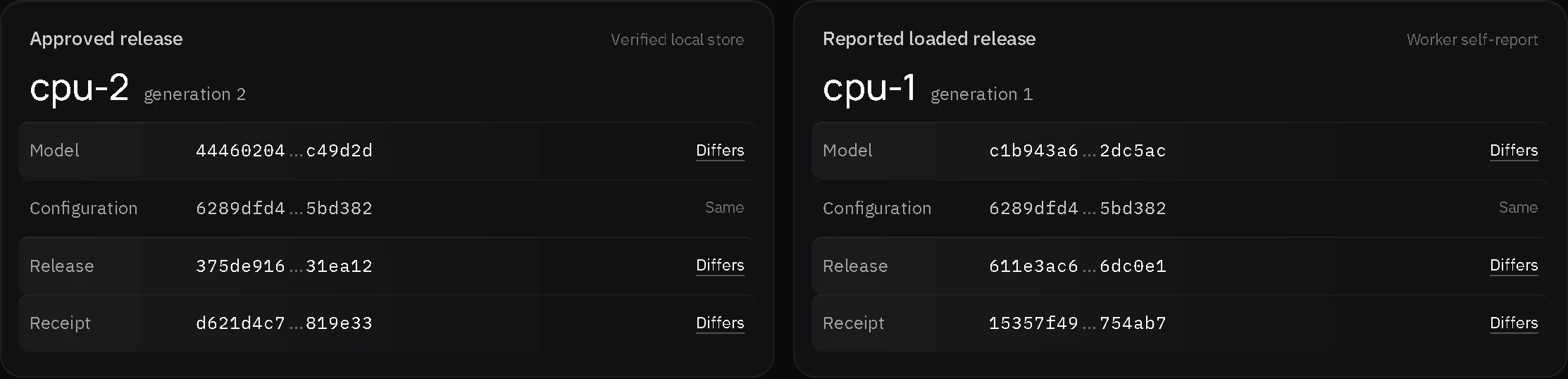
Compare approved and reported
A version mismatch shows as reload pending, not assumed.
Preserve discrepancies, missing evidence and recovery
Limits
What we do not claim.
- No deployments on robots or vehicles, and no customers.
- No robot or vehicle integration. The experiment is a synthetic ONNX CPU workload.
- No protection against adversarial inputs or perception attacks.
- No certification, and no evidence freshness for machines in the field: heartbeats are not built.
- No hardware attestation. Runtime identity is a worker self-report.
Related research
Build stronger evidence for model releases.
Join us in building Vraelis Contour.